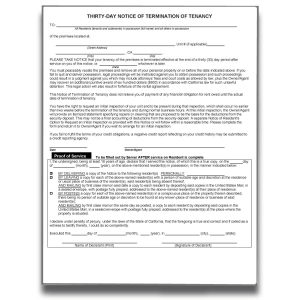

If a month-to-month rental agreement (tenancy-at-will) has lasted more than one year, a landlord must use a California 60 Day Notice to Terminate Tenancy. California Code 1946.1
This notice informs the tenant that the tenancy will end on a date that’s at least 60 days from when the notice is delivered. If the tenant refuses to move, the landlord may file an unlawful detainer lawsuit to evict.
How to Fill Out
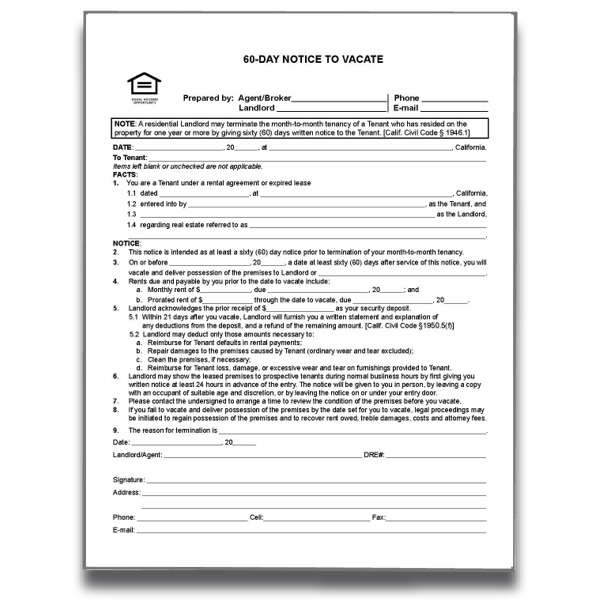
Step 1 – The person that prepares this notice must provide their name at the top and include their phone and email in the top right-hand corner.
Step 2 – Enter the date the notice is prepared and the street address and city of the rental property on the line before “California.”
Step 3 – Next to “To tenant” provide the full name of each person that signed the rental agreement that must surrender the property.
Step 4 – For item 1.1, the date when the rental agreement was signed must be entered along with the street address and city of the rental property (once again, on the line before “California”).
Step 5 – For item 1.2, the names of all tenants who signed the lease must be entered.
Step 6 – For item 1.3, provide the landlord name that appears in the rental agreement.
Step 7 – For Item 1.4, identify how the rental property is referred to in the lease if a unit number or an account number is used. If no such designation exists, then the street address may be used again.
Step 8 – In Item 3, the preparer must estimate the date that is at least 60 days after the tenant will receive this notice (enter the date just after the word “…before”). Then, on the space at the end of Item 3, enter the name of the entity or person the tenant may surrender the property to if the landlord is unavailable.
Step 9 – For Item 4, enter the amount in monthly rent that will be due and the date after the word “due.”
Step 10 – If a security deposit was collected from the tenant, the amount must be disclosed next.
Step 11 – Finally, the preparer needs to sign, date and complete the remaining contact information on the bottom of the notice. The DRE# only applies to agents/brokers.
Serving a Tenant in California
This notice will only go into effect when the tenant is served. You may deliver it personally to the tenant at their residence or place of business. You may also post it in a very conspicuous area where any reasonable person would discover it such as the front door (a copy should then also be mailed, certified). You also have the option present this to an adult at the dwelling unit (a copy should then also be mailed, certified).
Note: A landlord must allow an extra day if notice is not personally delivered to the tenant.
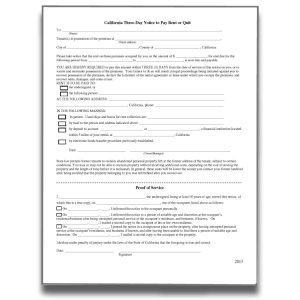
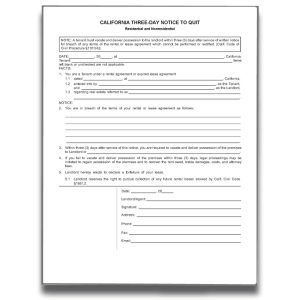
• Nonpayment of Rent: 3 days. CA Civ Pro Code § 1161(2)
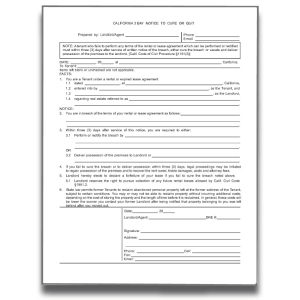
• Noncompliance: 3 days. CA Civ Pro Procedure §1161(3)
• Termination (Month-to-Month Lease): 30 days (<12 mos) 60 days (>12 mos). Calif. Civil Code § 1946.1
• Eviction Lawsuit: Unlawful detainer Calif. Civil Code 1159 – 1179a
Please read our Terms of Use. AmericanLandlord.com is not a substitute for consulting with a legal professional specializing in landlord-tenant law.