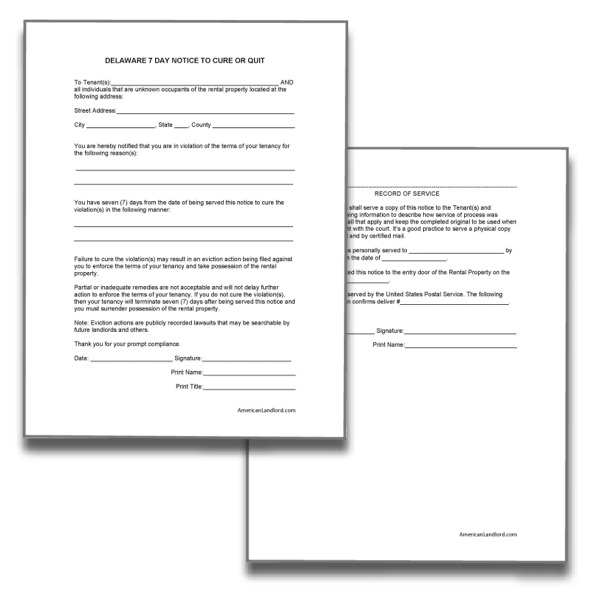

A 7 Day Notice to Cure or Quit is the 2nd most commonly used eviction notice in Delaware because it enforces all lease violations other than the nonpayment of rent and those which cause irreparable harm. Whether it’s an unauthorized pet or trash accumulating outside of the unit, this notice identifies and demands the violation to be cured with 7 days. Otherwise, the landlord can terminate the tenancy and file an eviction lawsuit if the tenant refuses to move.
What Does Delaware Law Say?
(a) If the tenant breaches any rule or covenant which is material to the rental agreement, the landlord shall notify the tenant of such breach in writing, and shall allow at least 7 days after such notice for remedy or correction of the breach. This section shall not apply to late payment of rent which is covered under § 5502 of this title.
(1) Such notice shall substantially specify the rule allegedly breached and advise the tenant that, if the violation continues after 7 days, the landlord may terminate the rental agreement and bring an action for summary possession. Such notice shall also state that it is given pursuant to this section, and if the tenant commits a substantially similar breach within 1 year, the landlord may rely upon such notice as grounds for initiating an action for summary possession. The issuance of a notice pursuant to this section does not establish that the initial breach of the rental agreement actually occurred for purposes of this section.
(2) If the tenant’s breach can be remedied by the landlord, as by cleaning, repairing, replacing a damaged item or the like, the landlord may so remedy the tenant’s breach and bill the tenant for the actual and reasonable costs of such remedy. Such billing shall be due and payable as additional rent, immediately upon receipt.
(3) If the tenant’s breach of a rule or covenant also constitutes a material breach of an obligation imposed upon tenants by a municipal, county or state code, ordinance or statute, the landlord may terminate the rental agreement and bring an action for summary possession.
(b) When a breach by a tenant causes or threatens to cause irreparable harm to any person or property, or the tenant is convicted of a class A misdemeanor or felony during the term of the tenancy which caused or threatened to cause irreparable harm to any person or property, the landlord may, without notice, remedy the breach and bill the tenant as provided in subsection (a) of this section; immediately terminate the rental agreement upon notice to the tenant and bring an action for summary possession; or do both.
(c) Upon notice to tenant, the landlord may bring an action or proceeding for waste or for breach of contract for damages suffered by the tenant’s wilful or negligent failure to comply with tenant’s responsibilities under the preceding section. The landlord may request a forthwith summons.
How to Fill Out
Step 1 – Complete the full name of the tenant(s).
Step 2 – Enter the rental property address.
Step 3 – Identify each violation.
Step 4 – The landlord must sign and date.
Step 5 – Once the notice is delivered, the person who served the notice must attest to how and when it was delivered by completing the Record of Service section.
• Nonpayment of Rent: 5 days. Title 25 § 5502
• Noncompliance: 7 days. Title 25 § 5513
• Irreparable Harm: Immediate. § 5513(b)
• Termination (Month-to-Month Lease): 60 days. § 5106
• Eviction Lawsuit: Tenant Obligations and Landlord Remedies Title 25, Chapter 55
Please read our Terms of Use. AmericanLandlord.com is not a substitute for consulting with a legal professional specializing in landlord-tenant law.